


The Role of Automation in Modern Solar Panel Production
Home / blogs
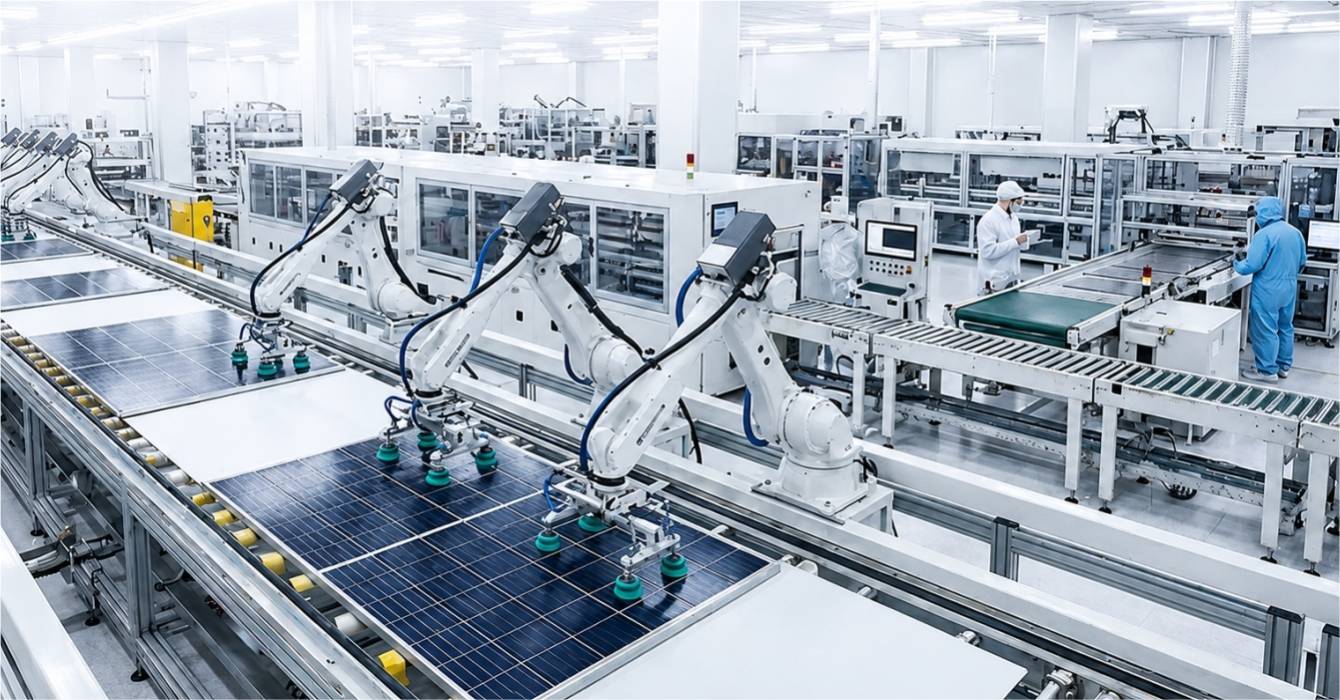
Impact of Technological Integration with AI and IoT in Solar Panel Production
By using AI-powered data analysis and IoT-enabled tracking, companies can save time and money while making new products. Automated systems keep an eye on every step of the panel manufacturing process all the time, so issues may be found and fixed quickly. This makes a lot less mistakes and makes the product better in general. Solar panels are now more reliable and less expensive because of this. This will help solar energy become more widespread around the world.
What Is Automation in Solar Panel Production?
When it comes to creating solar panels, “automation” involves using advanced technology, robotic systems, and computerized control systems to accomplish duties again and over again with little help from people. These systems use AI and the Internet of Things to keep an eye on, analyze, and improve every step of the production process. This includes everything from creating silicon wafers to put together the final panels and evaluating their quality when they are done
Greater operational efficiency (Increased Efficiency)
Automation boosts process efficiency by simplifying how raw materials, labor, and energy are handled. AI systems prove invaluable in pinpointing maintenance needs before they escalate into problems.
Cost Optimization (Cost Saving)
IoT sensors keep tabs on resource consumption, a move that reduces waste and, in turn, lowers costs.
Strengthened Quality Governance (Enhanced Quality Control)
Workforce Reallocation for High-Value Tasks
Improves Sustainability with Automation in Energy Consumption
Advancements in Industry 4.0 are leading to smarter solar operations.
Automation and the Circular Economy in Solar Panel Recycling
Enabling the Future of Solar with Next-Generation Technologies
Thanks to advancements in robotics, artificial intelligence, and the Internet of Things, solar companies are now able to optimize their manufacturing processes. These technologies enhance resource utilization, minimize waste, and improve efficiency throughout the lifespan of a solar panel. They will employ advanced techniques to predict the future course of the solar panel industry. The development of better materials and more automated manufacturing techniques will boost the performance of solar technology.
Future Trends in Automated Solar Manufacturing
AI-driven smart factories
Advanced robots and cobots
Packing, inspecting, and organizing the cells will involve both human workers and machines. The use of cobots in production lines markedly improves safety, accuracy, and productivity across the board. We’re also leveraging digital twins to streamline our processes. Digital twin technology offers manufacturers a powerful tool: the ability to construct virtual production lines. This innovation enables companies to experiment with novel ideas, pinpoint inefficiencies, and optimize their processes, all while keeping operational efficiency at a premium.
Predictive Maintenance for IoT
Quality Control Automation
Circular and Sustainable Production
Low-Carbon, Energy-Efficient Industrial Lines
Flexibility and modularity in production
Automation promises to inject more adaptability into manufacturing processes. This means design alterations can happen more swiftly, and new solar panel technologies—think bifacial and perovskite panels—can be integrated more rapidly.
Consequently, these advancements should help renewable energy sources gain traction worldwide, all while driving down manufacturing expenses. Simultaneously, automated construction techniques are reshaping the current manufacturing methods used to produce solar panels.
Computer simulations will become more and more important in the manufacture of solar panels. They will let engineers test and improve performance before they are put to use. AI and self-driving technology for industry will become quite popular.
Strong predictive analytics, smart manufacturing systems that work together, and collaborative robots (cobots) are all transforming how things are made. They all help producers work more effectively, respond more quickly to changing needs, and have less of an impact on the environment. As automation gets better, solar panel makers will be able to meet the world’s growing energy needs while also meeting strict quality and environmental standards.
The Internet of Things and artificial intelligence are two big forces behind this change. These technologies not only help lower the cost of solar panels, but they also help make the future greener and more environmentally friendly. AI and IoT make solar panels work better, last longer, and have better overall quality, which means that they are a good investment for both manufacturers and end users.