


Latest Trends in Solar Panel Cell Materials
Home / blogs

Why Advancements in Solar Panel Materials Matter?
Solar energy is becoming an integral part of our lives, visiting homes, businesses, and even cities. Solar panels must be made cheaper, but also powerful enough to meet soaring energy demands and fight climate change. That’s where the latest trend in solar materials comes in.
New materials coming in, like perovskites, push solar panel efficiencies much higher than ever before. If made with these new materials, solar panels with a price drop could allow thousands of people access to clean energy. By improving on solar panel materials, we are one step closer to making energy greener and more accessible to everyone.
The Journey of Solar Cell Materials: From Silicon to Advanced Composites
Observing the development of solar cell materials has been like seeing a technological baby being born. Although silicon screens were a positive start, many people are now dubious about the idea of using novel materials. Think about polymer solar cells. By 2023, they had improved their efficiency by 19.3%. It was already above 10% in 2015! Bendable panels and polymers are the latest trend in solar materials, breaking new ground and offering up intriguing new possibilities. The market for next-generation solar cells is expected to increase rapidly, from $2.53 billion in 2023 to $2.95 billion in 2024, at a pace of 16.6% per year.
Current State of Solar Panel Materials
Common Materials used Today
These days, materials utilized count a lot for the amount of energy captured by these solar panels emanating from the sun. Now let’s take a glance at a few of the most popular raw materials used for creating solar panels and how they contribute to powering the world:.
Silicon
First is Silicon. Silicon has been produced and used for decades. Moreover, it is still probably one of the most preferred products in solar panels. It is rather very efficient, durable, and so forth.
Thin-Film Solar Panels
With technology, in the not-so-distant past, thin-film solar panels have come of age because their material may be a cadmium telluride or amorphous silicon, which is essentially a non-crystalline form. They are lighter but flexible.
Copper Indium Gallium Selenide, or CIGS
This one seems to be a little mouthful. Still, let the term frighten you not. Another kind of thin-film material is CIGS, which has a step increase in efficiency.
Limitations of Existing Materials
Efficiency
Cost
Durability
Size and Space Requirements
Here is one that many people do not think about at first. Although silicon solar panels are more efficient than thin-film panels, they do take up a lot of space to generate enough power. Try to imagine powering your whole house with a bunch of large, bulky panels on your roof. If you have a small roof or live in a dense city, you might struggle to fit all the panels you need.
Energy Storage
Manufacturing and Material Limitations
The process of making solar panels is not as easy as it sounds. Silicon, for example, requires a lot of energy to produce, and that process isn’t always the most eco-friendly. While it’s still much better than burning fossil fuels, we’re always looking for ways to make production cleaner and cheaper. Thin-film panels are a bit better in this area, but they still have their own challenges. The materials used for the solar panels are not always easy to source in a sustainable manner, so that affects the overall environmental impact of solar energy.
Temperature Sensitivity
Aesthetic and Integration Problems
Let’s admit; solar panels sometimes take quite a bulky and unplaced image on the rooftop. Thin-film panel appears a bit flexible, integrates the building material such as the windows or rooftops yet seems not to have that sharp or sleek look everyone is targeting in the market. All would like to see designs from clean and modern styles without incorporating solar panels.
Emerging Trends in Solar Panel Cell Materials
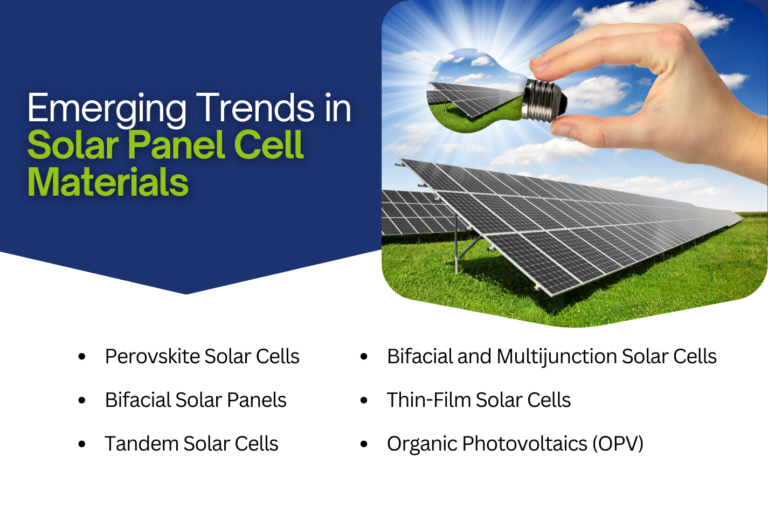
Let’s talk about some of the latest trends in solar materials that are really turning heads in the solar industry. These innovations are giving solar energy a major boost and bringing us closer to a cleaner, greener future.
1. Perovskite Solar Cells
2. Bifacial Solar Panels
3. Tandem Solar Cells
4. Bifacial and Multijunction Solar Cells
5. Thin-Film Solar Cells
Thin-film solar cells are lightweight and flexible, making them perfect for applications where traditional panels might be too bulky. They’re made from layers of semiconductor materials that are just a fraction of the thickness of silicon solar panels. They’re cheaper to produce and can be used on surfaces like windows or roofs where traditional panels wouldn’t fit.
6. Organic Photovoltaics (OPV)
OPVs use organic materials (basically carbon-based) to generate solar power. These panels are lightweight and flexible, just like thin-film solar cells, but with the added benefit of being more eco-friendly in production. Although they’re still behind in efficiency compared to silicon, their low-cost production and flexibility make them a great candidate for the future, especially in wearables or portable devices.
Other Advancements in Solar Industries
Nanotechnology in Solar Cells
Sustainability and Eco-Friendly Innovations
Improving on Methods of Manufacturing Techniques
But it’s not only material improvement, which also touches on how this is going to be achieved. One cool idea is the development of flexible and lightweight solar cells, which are perfect for portability. You might even see solar panels where conventional ones couldn’t—on backpacks or clothing! Then printable solar panels—whose panels are produced roll-to– roll—have become really popular. Like publishing a newspaper but using solar energy, this speeds up and lowers the manufacturing cost process! These developments are making solar energy not only more reasonably priced but also simpler to include into our everyday life.
Conclusion
The new trends in solar materials have opened exciting new avenues for collecting and utilizing energy. Notable and recognized advances include perovskite solar cells, bifacial panels, and organic photovoltaics, allowing greater energy efficiency, lower costs, and greater environmental sustainability for solar power.
The future of these innovations depends on research and investment that allow us to tap into new streams of renewable energy that may finally turn the tides. By warmly welcoming the encroaching solar transition into portions of our lives, either as investments or in support of greener options, any one of us can make a difference in creating an enthralled clean world thanks to solar energy.