


Formation of Categories of Solar Backsheets
Home / blogs

The solar backsheet is an important part of every solar panel. It is the top layer on the back of the panel. The main job of the solar module is to keep it safe from harm for as long as it works. It keeps the solar module safe from physical damage, chemical reactions, changes in the environment (like rain and humidity), and dust and other particles.
Solar backsheets are typically made from plastics that are bonded together in order to provide the necessary features of strength, flexibility, weather protection, and electrical insulation. Carefully picking plastics that work best in a range of weather conditions makes the solar panel system more reliable and efficient as a whole.
Types of Solar Backsheets
There are three main types of Solar Backsheets:
- Double Fluoropolymers
- Single Fluoropolymers
- Non–Fluoropolymers
Double Fluoropolymer
On the outside of the solar backsheet, Tedlar (PVF) or Kynar (PVDF) films are often used. Tedlar (PVF) is a polyvinyl fluoride film that has been used for a long time and in bad weather. PVDF film, which is made of polyvinylidene fluoride, can keep its qualities for a long time, even after being exposed to UV light.
Polyethylene terephthalate (PET) is often used to make the middle layer. The backsheet is strong and lasts a long time because of the PET. It was picked because it is strong physically, stays stable at high temperatures, and bonds layers well.
Types of Solar Backsheets
Weather Resistance
UV Protection
The double layers of fluoropolymer give the backsheet better UV resistance, which keeps it from breaking or changing color over time. This must be done to keep the solar backsheet film looking good and working right.
Mechanical Strength
Single Fluoropolymer
The solar backsheet in this economical design has an air-side fluoropolymer layer, a PET (polyethylene terephthalate) core, and an EVA (ethylene-vinyl acetate) or priming inner layer. A single layer of fluoropolymer (like Tedlar or Kynar) on the air side could save a lot of money on materials. Given that fluoropolymers are expensive, using less of them in the solar backsheet cuts costs without having a big effect on performance.
Properties of Single Fluoropolymer Backsheet
Chemical Resistant
Insulation
Adhesion and Flexibility
Non-Fluoropolymer
An ethylene-vinyl acetate (EVA) and polyethylene terephthalate (PET) starting layer is often part of multi-layer non-fluoropolymer backsheets. Most structures have three layers: two PET layers, an EVA or primer layer, and a third PET layer. The second PET layer is added as a core structure layer to make the backsheet stronger and more stable. PET is a great material for the backsheet because it is strong and doesn’t break easily when put under stress.
For the top coat, you can use primers or EVA. This layer is necessary for the material that surrounds the solar cells to stick well to the backsheet. The primer or EVA covering not only makes the backsheet last longer, but it also makes it more flexible.
Properties of Non-Fluoropolymer Backsheet
Durability of Surface
The solar backsheet film is shielded from physical damage caused by environmental pollutants and mechanical cleaning operations by using modern non-fluoropolymer PET films, which have improved abrasion resistance.
Lower Density of Materials
Advanced Polyester Chemistry
Non-Fluoropolymer
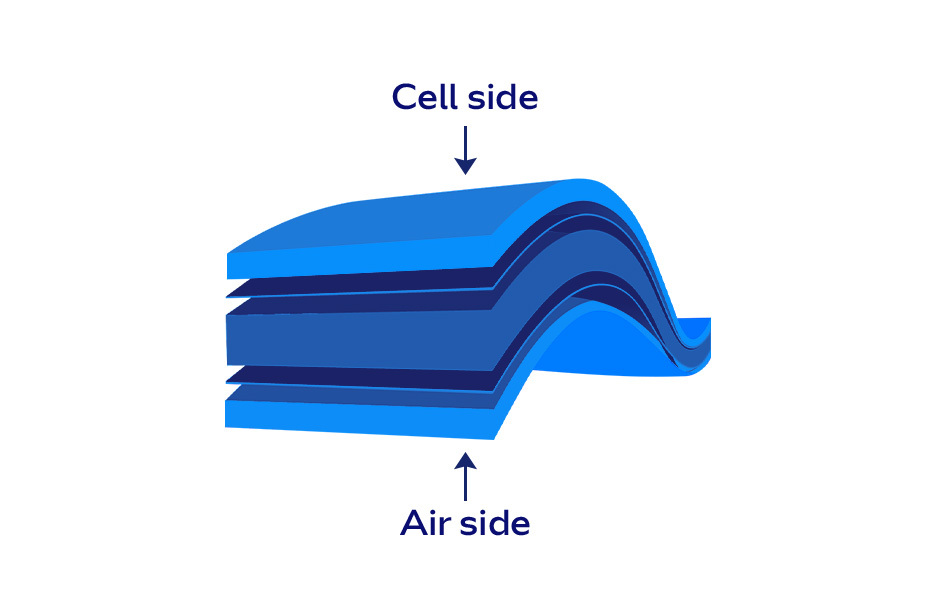
Air Side Layers
Intrinsic Weathering Stability
The air side layer is crucial for the lifespan of the product due to its intrinsic weathering stability, since the solar back sheet is the protective layer. UV light is not a problem for photovoltaic backsheets made of PVF and PVDF. Fluoropolymers are naturally robust and don’t break down quickly when exposed to sunlight. They also keep water out of the solar panel, which keeps it from rusting, having electricity problems, and losing power.
Resistance to Abrasion
Backsheets today are made to be more resistant to wear, whether they are made of PET or fluoropolymers. This feature keeps airborne particles from getting to the backsheet, which keeps the solar panel’s visual clarity and guarantees its long-term durability.
Resistant to Tear, Crack, and Physical Deformation
The backsheet’s superior materials prevent tears from spreading. Cracks don’t occur even when fluoropolymer is subjected to mechanical stress or temperature fluctuations since it is inherently robust and flexible. Thus, the backsheet will remain intact and functional as long as the product operates.
Thermal Stability
Protects Inner Core
Inner Layer
Insulation
Mechanical Stability
Vapor Barrier
Hydrolytic Stability
The term “hydrolytic stability” describes a material’s capacity to withstand deterioration over time in environments with high humidity and temperatures. In order to determine the inner PET layer’s hydrolytic stability, it is subjected to stringent testing, including the Pressure Cooker test (PCT). For the PET layer to be stable and dependable in harsh environments, it usually needs a PCT rating of at least 48 hours at 120°C/100% RH/2 atm.
Cell Side
Protects Inner Core PET Film
The air side layer is crucial for the lifespan of the product due to its intrinsic weathering stability, since the solar back sheet is the protective layer. UV light is not a problem for photovoltaic backsheets made of PVF and PVDF. Fluoropolymers are naturally robust and don’t break down quickly when exposed to sunlight. They also keep water out of the solar panel, which keeps it from rusting, having electricity problems, and losing power.
Thermal Stability
UV-Stable
Electrical Insulation
Adhesion to Core Film and Encapsulant such as EVA
High Reluctance
Heat Dissipation
The coating on the side of the cell allows for efficient heat dissipation, which helps keep the solar panel at a consistent temperature. The PV cells’ performance and operating lifetime are optimized and extended when heat is effectively dissipated, preventing them from overheating.
To sum up, solar backsheets play an important role for photovoltaic module efficiency, durability, and reliability. Vishakha Renewables stands out as a top solar backsheet manufacturer in India, providing a variety of high-quality backsheets made from materials including Polyethylene Terephthalate (PET), Polyvinyl Fluoride (PVF), and Polyvinylidene Fluoride.
Vishakha Renewables plays a major role in creating a sustainable future by supporting the ‘Make in India’ program and putting an emphasis on eco-friendly solutions. In addition to protecting solar PV systems from external elements like moisture and UV radiation, their rust-proof backsheets boost their longevity, guaranteeing maximum performance in the long run.