


Encapsulants in Solar Panels: EVA, POE, and EPE for Different Cell Technologies
Home / blogs
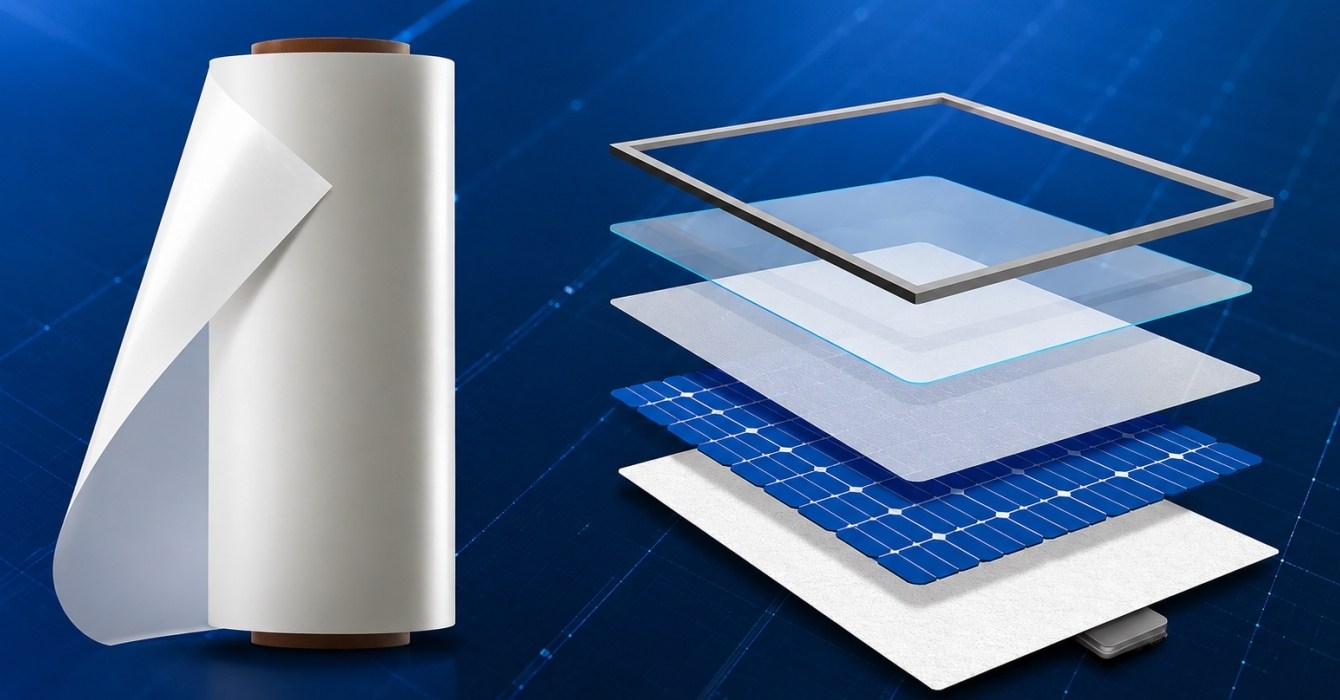
Solar panels power a lot around you. They’re on rooftops, in solar parks, and even floating on water in some places. But have you ever thought about what makes a solar panel last for years in the sun, rain, and dust? Solar encapsulants help here.
When building solar panels, these items are essential. They provide a protective barrier by sitting directly on top of the solar cells. So, what exactly is their primary function? Protect the solar cells and check that they continue to function properly after many years of usage.
What makes EVA, POE, and EPE, three of the most popular encapsulants, so important in solar applications? We’ll examine these and more today.
What are Solar Encapsulants?
Solar Encapsulants are the clear sheets you don’t usually see, but they’re right inside every solar panel, quietly doing a big job. Their main role is to protect the solar cells, those tiny parts inside the panel that actually convert sunlight into electricity. Without encapsulants, the cells would get ruined pretty quickly by moisture, dust, heat, or sunlight.
Now, for these materials to really work well, they have to tick a few boxes. They need to be see-through, stick well to the panel parts, and handle heat and sunlight without falling apart. If one of those things is off, the whole panel might stop working right. So, you can say these encapsulants are really holding down the fort. They’re one of those parts people don’t talk about much, but without them, solar panels wouldn’t stand the test of time.
Advantages of EVA: The Market Leader
Cost Effectiveness
To start, it is a very cost-effective choice. This means that concentrated costs on the materials are not too burdensome to budget for, which is always important. When companies can utilize a material that is cost-effective without failings to palpably reduce quality, they are most likely to stick with that product.
Good Optical Properties
Established Supply Chain
Limitations of EVA
Turns yellow after being exposed to Sunlight for a Long Time
Acetic Acid can form Inside the Panel
Common applications of EVA
- EVA is still widely used in crystalline silicon (c-Si) modules.
- It works really well with both mono and multi-crystalline cells.
POE (Polyolefin Elastomer): Enhanced Durability for High-Performance Cells
Advantages of Polyolefin Elastomer
Excellent protection against moisture
Strong resistance to PID or Potential Induced Degradation
Better long-term UV stability compared to EVA
EPE (EVA-POE-EVA Tri-layer Structure): A Hybrid Solution
Structure of EPE
Advantages of EPE
Cost and performance
Adhesion and PID resistance
Clarity and durability
Applications of EPE
TOPCon and HJT cells
With the increased use of TOPCon EPE and HJT cells, which are high-efficiency cells that need good protection.
Glass-glass modules
Selection of Encapsulant Based on Cell Technology
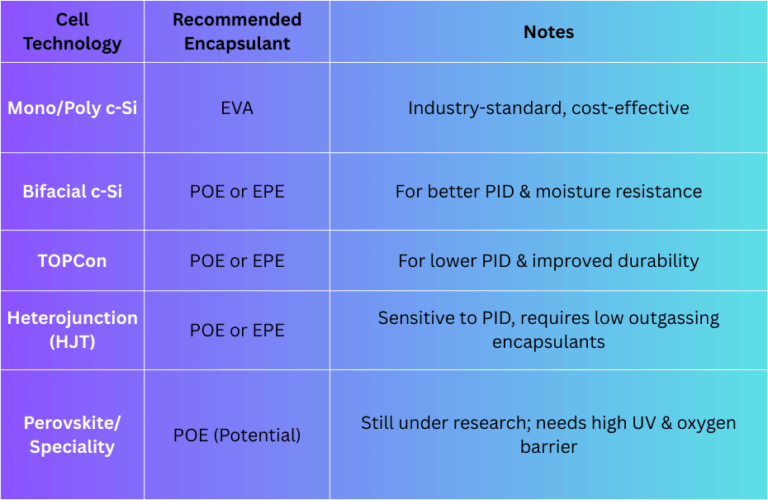
Market Trends and Future Outlook of Solar Encapsulant
So, where are things heading?
Right now, EVA is still leading, no doubt. It’s trusted, affordable, and easy to use. But with the rise of bifacial panels and newer cell technologies, materials like POE and EPE are getting more attention than ever.
In fact, POE is expected to grow at a CAGR of over 15 percent through 2028. That’s mostly because more people are choosing glass-glass modules and advanced solar cells, which need tougher protection.
There’s also some interesting work happening in labs and factories. New types of encapsulants are being explored, like thermoplastic-based materials and UV-curable resins. These might make the whole panel-making process even quicker and more reliable in the future.
Before we wrap up, let’s touch on something exciting: Virtual Reality (VR). VR is starting to play a role in training, monitoring, and designing solar panel systems. With VR, engineers and technicians can plan panel placements, check issues remotely, and train teams faster and more safely.
The future looks bright for solar energy, and with these advancements, we’re likely to see even more efficiency and reliability. As far as adopting cutting-edge technology is concerned, Vishakha Renewables is always at the forefront.
Get in touch with us right now if you are interested in beginning the process of using our first-rate solar solutions to power your company. Want to stay ahead of the curve and explore the best solar solutions for your needs? Reach out today!